
For anyone who needs to hear this – resolutions are not exclusively reserved for the beginning of a new year. You can set them anytime – On Mondays, the 1st of the month, your birthday, a new moon, or any time that signifies a fresh start for you. Below is a comprehensive and versatile guide to setting realistic goals you can achieve with concrete and actionable steps.
Here is a TL:DR on the steps before we dive in:
- Analyzing the past
- Get a sense of a general direction
- Creating categories and themes
- Map out step-by-step plan (actionable)
- Repeated to-dos (frequency & measurability)
- Review & Optimize (habit tracking template included!)
- Reap the reward of your hard work!
What you can get out of this exercise:
- A guiding compass for your future self (a gift of wisdom from you to you)
- Reduction in anxiety and rumination on what you need/should/have to do and when you should do it (aka, tranquillity)
- Reduction in guilt when you are resting or taking a break (a well-deserved break)
- Time will slow down because you know exactly what you did (no more – geez, can you believe it’s x month already?)
- Increase in meaningfulness and contentment of daily life (learning to appreciate the small things)
- A peace of mind knowing what you’re working towards (trusting the process that you built for yourself)
*Note: The entire process can take between 2-5 hours, so I highly recommend going through this guide with a friend to bounce ideas off each other; it will be twice the fun! Also, feel free to pick and choose sections that resonate since everyone is on different parts of the self-development journey.
Lastly, if you’d like to bounce ideas with me, drop me a comment!
Now, let the manifestation begin!
Table of Content
- Step 1: Concluding The Past
- Step 2: Clarifying Directions
- Step 3: Making The Directions Actionable and Measurable
- Step 4: Review & Optimize
- Things You Should Know
- Conclusion
Step 1: Concluding The Past
Wait. Before you roll your eyes and click exit, hear me out!
Regular reviews and conclusions are a great form of self-discovery; they reveal patterns and themes that may have gone unnoticed through the day-to-day motions. Think of it as data collection but for yourself. You research for school or work to ensure accuracy; why not do the same for your personal life? We should all be the scientists/project managers/CEOs of our own lives where we regularly review and conclude to better align and improve for the future.
If you have not set any goals before, no worries. You have a past, and there are plenty of data. Here are some prompts to get you started:
- Without conscious editing, write out the top moments that come to mind in the past little while or year. The key here is to let the thoughts flow, no matter how big or small the moments appear.
- What were you doing at the time?
- How did you feel?
- What makes those moments stand out?
- What were some of the lowest moments, pain points, or biggest obstacles that come to mind?
- Did you overcome those moments or obstacles? Why or why not?
- How did you feel at the time?
- Why do you think you felt the way you did?
- With the outcome remaining unchanged, what would you have done differently? Why or why not?
- If someone was going through the same situation as you, what advice would you give them?
- What were some of your accomplishments?
- How did it make you feel?
- Why did it feel like an accomplishment?
- Who did you share the good news with?
- Is there anyone you wish you could share the news with but have not? How come?
*Note: The repetitiveness is the intent.
Review your answers and highlight keywords or phrases that stand out to you. Then, jot down one or more categories/themes besides each answer to summarize it to the best of your ability. The categories/themes can be anything; it only needs to make sense to you. When I began this process in 2022, I had categories like sparking creativity, close connections, financial intelligence, organization & documentation.
Here are some categories for inspiration:
- Relationships
- Friendships
- Love
- Family
- Travel
- New experiences
- Hobbies
- Learning
- Career
- Finance
- Budget
- Savings
- Self-development
- Habits
- Discipline
- Health & Fitness
- Creativity
- Mental Health
- Rest
- Slow Living
If you have a lot of overlapping and repeating categories or themes within your answers, consider it a hint to what brings you joy, what you want to work on, and things that are important to you right now. If you have many one-off items that do not fit neatly into a category or theme, look at your answers with a different lens to find a common thread that connects them. For example, if I listed out my top highlights as the following items:
- Learning to fence (Hobbies)
- Entering fencing competitions (Hobbies)
- Navigated through ambiguous work environments by carving out my own processes and responsibilities (Work)
- Consistently staying active (Fitness)
- Started a blog (Hobbies)
Each item appears disconnected because they all belong to different categories. However, a central theme could be that each item required me to step outside my comfort zone. For example, I took the first step in learning a new hobby; I mustered up the courage to enter competitions; I established my grounds at work by setting boundaries and processes; I consistently pushed myself to show up for workouts; and I poured a part of myself out on the internet for strangers to view. All of a sudden, there is a common thread connecting each item. I can argue my top moments of the year came from the many times I went out of my comfort zone and maybe I should keep that up! Eureka!
Is it a stretch? Sure, it can be a stretch for someone else reading this, but remember, this is a conversation between you and only you. The connections can be sliced and diced in any way that makes sense to you! If you do not like the going outside of your comfort zone approach, you can go with the view of trying something new, doing hard things, or having courage. You get to choose the direction you want to focus your efforts on, and once you establish those directions, hold on to them; we will need them later.
Step 2: Clarifying Directions
Congrats on getting through Step 1; that was tough and probably emotionally draining. The good news is we are halfway there!
Step 2A: Making THE List
Time to make a list! (*Excited squeal*)
List everything, and I mean everything floating around your head on what you want to do, achieve, or be. Are you an overthinker? Here is your permission to unleash that floodgate! The list can include things you need to do tomorrow because it is an errand, or it could be academic, career, and or lifestyle goals you want to achieve. It could also simply be a state of mind you want to be in.
Fill the page with everything you want, should, must, ought, and have to do. We are casting a wide net here. No matter if the timeframe is tomorrow, next week, next month, 2024, or beyond. Even if you’re thinking of the same thing but in different phrases. Just. List. It. All.
It is a list that ends all lists, but no pressure. You can always come back and make changes to it. And I mean it.
Ready? Go. Make that list sis!
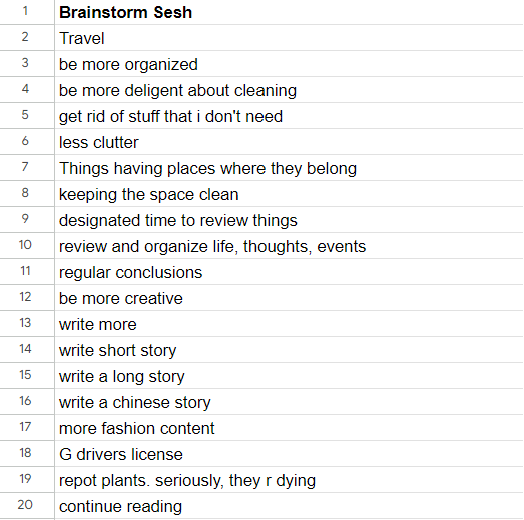
Here are some prompts to buff out your list in case you need them:
- What are some items/categories from Step 1 that you can add to the list?
- Think about the directions you came up with in Step 1. What are some things you can do to move you towards those directions?
- What’s been on your mind for a while now, and you’ve always wanted to do?
- What’s the voice inside your head been nagging you about?
- What’s that thing that you should do but you just haven’t?
- What’s something that you want to do, but you keep saying “Yeah, but I can’t because…” or “I’ll wait until…before starting?”
- What are some changes that’d be nice to see in a week, a month, and a year from now?
- What would you like to have?
- Wouldn’t it be nice if you could/were…?
*Note: The repetitiveness is the intent.
There is no correct number of items. You can stop at 3 or 100. Keep listing if you can; stop if you are out of ideas. You can always come back and add to it later.
Step 2B: Categorize the List
Time to categorize each item again, similar to step 1! I like doing this type of brainstorming on Google Sheets because it is easy to change things around. I can have the list in Column A and add categories in Column B beside each item. It might end up looking something like below, and again, these categories only need to make sense to you. Nothing is set in stone. It can be anything you want. There are no right or wrong answers to this.

Step 2C: Pivot Table the List (Optional)
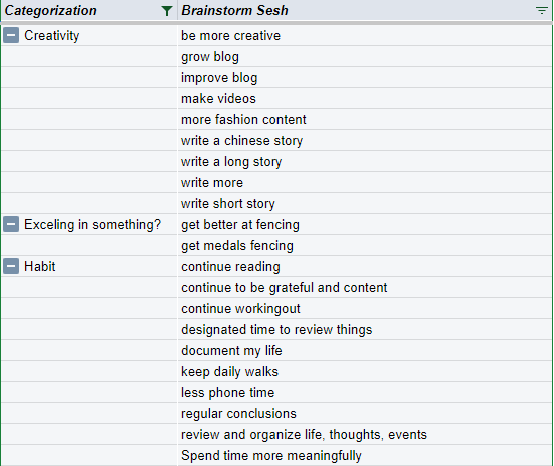
After the first draft of categorization, it should be apparent what the reoccurring categories are, and it indicates the directions you want to focus on. You can create a pivot table in Google Sheets for a summarized view.
To create a pivot table, highlight cells across columns A and B and click “insert” -> “Pivot table” through the menu bar at the top. For more guidance on creating a pivot table, check out my Step-by-Step Guide on How to Start a Budget post for screenshots and instructions.
By the end, the organized table should look something like this:
Step 3: Making The Directions Actionable and Measurable
By now, I hope you have a clearer idea of what you want to focus on. The themes and categories repeatedly mentioned in the previous steps are a good hint! For step 3, the goal is to make those categories and themes actionable and measurable. We already know the general direction we want to go; now, it is time to map out a path.
*Disclaimer: the following section is probably the most non-straightforward part of this entire process because, again, it’s what makes sense to you. There are many caveats, but I will do my best to walk you through the framework.
Actionable
The key to making an item actionable is to break it up into bite-size to-dos, and I mean the tiniest steps possible; it will make any daunting task more doable, and it will give you a dopamine hit every time you cross off a to-do because you are one step closer to the grand goal.
List out the step-by-step to-dos for each item on your list. Say you want to be more active; the to-do list may look something like this:
- Research suitable workout activities
- Research facilities that offer such activities
- Research workout clothes
- Research workout equipment if needed
- Purchase workout clothes
- Purchase workout equipment if needed
- Set schedule to attend workout (trial & error required)
Churning out an anticipatory list like this carves out a path in the general direction of wanting to be more active; it also reduces ambiguity as you’re anticipating all the things that may overwhelm and prevent you from starting. Lastly, it serves as a good reminder of what you can do when you have some time to kill.
*Note: This is my personal preference because I like to get into the nitty-gritty details (it can be counterproductive sometimes). If you prefer to stay at a higher level for these tasks, you do you!
Measurable
Rome wasn’t built in one day, so even though you carved out a path by listing out the to-dos, you may need to repeatedly complete some of the to-dos over a period of time. A frequency of repeating the to-dos needs to be set, such as the number of times you want to be active each week.
When coming up with the frequency of the to-dos, consider the resources that you have available, such as time, money, energy, motivational level, etc. When I say resources you have available, I mean the amount you have, not the amount you think you have. This is where “reviewing the past little while” from step 1 on the obstacles/pain points you experienced can come in handy. Be honest with yourself about how much resources you have!
Below are some concrete examples of how to make a goal actionable and measurable.
Sample Frameworks
Goal No.1: Being More Active
We’ll continue to use being more active as an example since it frequents the resolution list. We already reduced the ambiguity of “being more active” by breaking out the individual to-dos. Now, we can make it measurable by setting up the frequency.
Assuming you decided on weight training and yoga after some research, what’s the duration and frequency at which you can do those activities? One hour of weight training and thirty minutes of yoga every day would be great, but can you do that after a one-hour commute from your 9-5? Not to mention other responsibilities, such as buying groceries, cooking, and chores. Don’t even get me started if you have kids.
Think about your resources honestly, and set something realistic. There’s no shame in starting small; it’s better than not starting or giving up shortly after. Goals like “being more active” are a marathon, not a sprint, and there is always room for readjustment.
In the end, your activity frequency may look like something below:
- 5 minutes of stretching after waking up
- 3 one hour sessions of weight training per week
- Going on a 10 mins walk after dinner
Small habits are easier to build. Once you become used to the small habits you can slowly expand them by building on top of it. The goal is not to go from zero to one hundred as quickly as possible. The goal is to slowly and sustainably build up a routine that works for you.
Goal No 2: Growing This Blog
Let’s use my goal of “growing this blog” as a second example. The statement is pretty vague on its own, but I know I need to work on the blog for it to grow. Duh.
To make the goal more actionable, I mapped out a path and broke it down further with additional to-dos. I also added frequency where I felt applicable:
- Consistently publish posts once per month, 12 times a year
- Write for a minimum of 10 minutes a day
- Learn the ins and outs of running a successful blog
- Drive traffic to the blog
- SEO research
- Pinterest research
- Cross-post on Medium
- Be active on Reddit
- Branch out into different types of content
- Make at least two posts in video format
- Make one fencing-related video
- Experiment with fashion content
- Document OOTDs
- Make at least two posts in video format
- Branch out into different types of content
- Document in short video format
Here is the logic:
- The most important task of growing a blog requires consistency in content creation. Everything builds on top of quality content since readers will not stick around an empty blog.
- Hence, setting a realistic frequency of how often to write and publish is crucial, especially taking into consideration my 9-5 job, chores, hobbies, relationships, habits, and other responsibilities that I maintain on a day-to-day basis.
- After some pondering, I can probably keep up with one post a month with a minimum of 10 minutes of daily writing.
- The hope is to continue writing after 10 minutes; the short duration is a cheap bargain to trick my brain into doing it in the first place because “I just need to last for 10 minutes.” Once I get into the flow, I may keep writing for hours.
- (Evidently, it is working. I cranked out this post using this method)
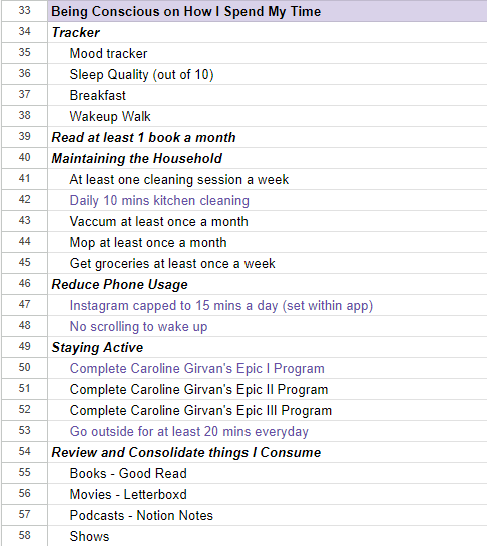
Run through the same process for each item on your list, and you will have a set of directions with clearly mapped paths that you can reference throughout the year. When you feel lost, bored, or unsure of what to do, look at this guiding compass you worked hard on. It is a gift of wisdom that you prepared for your future self.
Here is a section of the final list I set up for last year (2023) as an example:
Step 4: Review & Optimize
You’ve put in a lot of hard work so far; if you want to exponentially increase the benefits you can reap from this exercise, I urge you to regularly review and optimize the map you created. The review timeline is up to you, weekly, monthly, quarterly – as long as you do it and start with the following questions:
- What went well? What’s been working?
- What didn’t go well? What’s not working?
- What needs to be adjusted going forward?
- Are there any changes to your goals, priorities, and resources?
Maybe the workout schedule you set has been working really well for the past 6 months. Great! You may want to add the next thing you want to work on. Or, perhaps you have a list of items you know you need to complete. For whatever reason, you haven’t gotten around to it, as if you’re avoiding it. You may want to ask yourself if those items are truly important to you. What is the motivation behind completing the task? Is it internal or external? This is all a part of the data collection that you’re doing to discover who you are, what you care about, and what’s important to you that will lead you step-by-step in the direction you truly want. Don’t skimp out on this, you’ve already done so much!
Habit Tracking Template
Here is a habit tracking template to seal the deal of measurability and regular reviews. It ain’t pretty, but now that I tested it out for a couple of weeks, I am pretty happy with how it turned out. You can copy it to your Google Drive and make adjustments as you like!
Katelsy.ca – 2024 Habit Tracking Template
I also added a template for a daily gratitude journal in a tab called “Things that made me happy” for you to jot down the tiniest things that brought you joy. It may be just what you need to get yourself out of a rut – read the “celebrate the small wins” section below on why it’s important.
Things You Should Know
If you’re in the mood to be nagged, you’re in luck! I have some more messages for you as you embark on this journey.
You Will Fail
You will not complete all the items you set out in the plan. Sorry to burst your bubble, but even the best of us lose motivation and discipline throughout the year. Our energy level waxes and wanes, things change, priorities change, and sometimes goals simply stop aligning with a future phase of your life even though it seems like a great idea currently. It is A-Okay. Change takes time, and not only that, it takes many trials and errors to find what really works for you. Do not let disruptions and setbacks get you down; recalibrate and readjust with the new information you learned. Rome wasn’t built in one day. This is a marathon, not a sprint. You’ll get tired and maybe even stop, but what’s important is picking yourself back up and starting again. You got this.
Let It Marinate
This entire process is completely adjustable at any point in time. You may feel motivated to begin immediately, but there’s also no harm in letting this plan sit for a while. Let it marinate and incubate. I started planning for 2024 back in November, so I had more than enough time to simmer. I added new inspirations and changed my mind on some of the directions, and I’m sure you will too. Give yourself some time to incubate – A healthy dose of procrastination fuels creativity, given you’re actively thinking about the things you’re procrastinating on.
Pick A Couple of Items to Start
Enforcing a new habit takes a lot of mental capacity, so only focus on a couple of items at a time. Do not try to do everything all at once. We rather start slow than burn out.
When the new task becomes a routine, you will have more bandwidth to begin a new habit. I say this with experience because this is exactly how I built the habits of going on daily walks, working out, reading, and journaling; I built them one at a time. This year, I’ll go through the same motions with writing. I might take 20 days to finish a post right now, but starting small with a tiny amount of commitment at 10 minutes a day, I’ll become more and more efficient. I did this enough times to know it will be true. Once it takes me less time to do the current task, I can decide what to do with the newly freed-up time: keep writing, or better yet, I already have a list of the next steps ready. Before I know it, I will be making my way down the list, and hopefully, by the end of the year, this blog will be able to help more readers!
You Can’t Control The Result
You can control your actions and yourself, but you cannot control the result. For example:
I want to place top three in a fencing competition. Except, how the competition will turn out is entirely out of my control. I can, however, control my actions by regularly going to classes, drop-ins, and competitions. I’ll take notes on lessons I learned, and focus on something new to work on every week. These are all things I can control to ensure I perform my best in competitions. The goal is to get better and improve at fencing, not to place top three in a competition, because tournament placement is not entirely within my control.
If you’re looking for a new relationship, whether it be friendship or a romantic partner, what you can control is being active and taking initiative in meeting new people. You can’t control when or how you’ll meet them, but you can take ownership of what you do, how you feel, and how you react!
Focus on controlling the process and not the result.
Celebrate The Small Wins
I keep a daily journal of the things that made me happy; it includes anything from “The sun came out during my walk” to “I didn’t want to work out today, but I’m glad I did.” Each tiny happy moment gives me the potential to launch myself out of a depressive orbit if I am in one, or if I’m doing okay, it can intensify the enjoyment of my day. Each moment of content is collected and stored until you reach a critical momentum to get things rolling; this is how you’ll eventually find yourself swinging on the positive side again.
Conclusion
You know yourself best, and you know what you need to do. All you need is a little bit of patience, not just in the process, but also with yourself. No matter where you are in your self-development journey, you got this, we got this, and I have no doubt we can make 2024 a year where we know where the time went. For those of you who are starting from point zero, this will be a great stepping stone year that you look back on, you will thank yourself for putting in the hard work, and the gift of wisdom that you prepared for your future self.
Share the directions you’re working on below, and let’s cheer each other on!
Good luck!
Kate LSY
 Kate LSY
Leave a comment